


The voltage of a LiFePO4 battery is a crucial indicator of its state of charge and performance. Whether in motorhomes, solar power systems, or electric vehicles – understanding the relationship between voltage and state of charge is essential for optimal battery utilization and extending its lifespan.
This article explains how to correctly assess your battery's state of charge based on its voltage. We provide a state-of-charge battery chart for 12V, 24V, 48V, and 72V LiFePO4, AGM, and gel batteries, explain the most important influencing factors, and offer valuable battery maintenance tips. The LiFePO4 voltage state-of-charge chart is particularly useful, helping you to precisely determine the current battery condition.
Contents
- What is a battery charge level table?
- Different types of batteries
- LiFePO4 charging voltage curve
- LiFePO4 Voltage State of Charge Table - Common Voltages
- LiFePO4 Voltage State of Charge Table - High Voltage
- Battery charge level table AGM 12V/24V
- Gel battery charge level table 12V/24V
- Bonus tip: How can you measure the battery voltage?
- FAQs about LiFePO4 voltage state of charge table
- Conclusion
What is a battery charge level table?
Since the state of charge cannot be measured directly, but only indirectly via the battery voltage, you need a battery state of charge table. A battery state of charge table is an overview that shows how the state of charge (SOC) of a battery relates to its measured voltage. Such tables are particularly useful for checking batteries in various applications.
However, different battery voltage values with corresponding states of charge (SOCs) vary. This article aims to summarize all the information you need for a quick reference. First, we can begin by defining the battery types mentioned below, so you can verify that the described battery matches the one you intend to measure.
Different types of batteries

LiFePO4 battery
A LiFePO4 battery (lithium iron phosphate battery) is a special type of lithium battery that uses iron phosphate as the cathode material. It offers high safety, a long lifespan, and stable performance, although it has a lower energy density compared to other lithium batteries. These batteries are particularly suitable for applications in solar energy storage, electric vehicles, and emergency power systems.
Gel battery
A gel battery is a lead-acid battery in which the electrolyte is in gel form, making it leak-proof and maintenance-free. It offers a long service life and is frequently used in solar power systems and emergency power systems.
AGM battery
An AGM battery uses fiberglass mats to absorb the electrolyte. It is robust, requires little maintenance, and is well-suited for high-performance applications such as cars and motorcycles.
Learn more:
AGM vs.Gel battery for motorhomes: Which is the better choice?
AGM battery disadvantages in comparison: boat, car & Camping problems
LiFePO4 charging voltage curve
The LiFePO4 charging voltage curve describes the typical voltage profile during the charging process of a LiFePO4 battery. It shows how the battery voltage changes in different charging phases, depending on the charging current and state of charge (SOC).
It is worth noting that LiFePO4, unlike other conventional batteries, has a two-stage charging process:
- Constant current phase (CC, Constant Current) – The battery is charged with a constant current, and the voltage gradually increases.
- Constant voltage phase (CV, Constant Voltage) – Once the battery voltage reaches the maximum charging voltage (e.g. 14.6V for a 12V battery), the charging current is gradually reduced until the battery is fully charged.

This means that the battery voltage does not increase uniformly with the state of charge. Once a certain threshold is reached, the battery capacity can change abruptly. Therefore, the values in the LiFePO4 state of charge table serve only as a guideline. For more accurate monitoring of the battery's condition, the use of a BMS (Battery Management System) or a dedicated battery monitor is recommended.
LiFePO4 Voltage State of Charge Table - Common Voltages

The most commonly used lithium batteries are 12V and 24V batteries. Below is a table with the corresponding voltages for 12V/24V LiFePO4 batteries. You can use the table to check whether your battery's charge level is correct.
| State of charge (SOC) | 12V battery voltage (V) | 24V battery voltage (V) | Description |
|---|---|---|---|
| 100% | 13.6 | 27.2 | Fully loaded |
| 90% | 13.4 | 26.8 | Good capacity |
| 80% | 13.3 | 26.6 | Good capacity |
| 70% | 13.2 | 26.4 | Good capacity |
| 60% | 13.1 | 26.1 | Partially unloaded |
| 50% | 13 | 26 | Partially unloaded |
| 40% | 13 | 26 | Low capacity, charge soon |
| 30% | 12.9 | 25.8 | Low capacity, charge soon |
| 20% | 12.8 | 25.6 | Deep discharge, risk of damage |
| 10% | 12 | 24 | Deep discharge, risk of damage |
| 0% | 10 | 20 | Deep discharge, risk of damage |
If you are looking for a suitable battery, discover our 12V LiFePO4 batteries from LiTime – ideal for motorhomes, solar systems and off-grid systems.
LiFePO4 Voltage State of Charge Table - High Voltage
48V and 72V LiFePO4 batteries are used in high-performance applications. 48V models are ideal for solar systems, UPS systems, e-bikes, and golf carts, while 72V batteries are found in electric motorcycles and industrial equipment. Their state of charge varies depending on the application. The following LiFePO4 voltage state of charge table shows the optimal values for 48V and 72V batteries.
LiFePO4 state of charge table 48v
| State of charge (SOC) | 48V battery voltage (V) | Description |
|---|---|---|
| 100% | 54.4 | Fully loaded |
| 90% | 53.6 | Good capacity |
| 80% | 53.12 | Good capacity |
| 70% | 52.8 | Good capacity |
| 60% | 52.32 | Partially unloaded |
| 50% | 52.16 | Partially unloaded |
| 40% | 52 | Low capacity, charge soon |
| 30% | 51.52 | Low capacity, charge soon |
| 20% | 51.2 | Deep discharge, risk of damage |
| 10% | 48 | Deep discharge, risk of damage |
| 0% | 40 | Deep discharge, risk of damage |
SOC voltages of LiFePO4 72V
| State of charge (SOC) | 72V battery voltage (V) | Description |
|---|---|---|
| 100% | 87.6 | Fully loaded |
| 90% | 86.4 | Good capacity |
| 80% | 85.2 | Good capacity |
| 70% | 84.0 | Good capacity |
| 60% | 82.8 | Partially unloaded |
| 50% | 81.6 | Partially unloaded |
| 40% | 80.4 | Low capacity, charge soon |
| 30% | 79.2 | Low capacity, charge soon |
| 20% | 78.0 | Deep discharge, risk of damage |
| 10% | 76.8 | Deep discharge, risk of damage |
| 0% | 72 | Deep discharge, risk of damage |
Battery charge level table AGM 12V/24V
| State of charge (SOC) | 12V battery voltage (V) | 24V battery voltage (V) | Description |
|---|---|---|---|
| 100% | 12.8V - 13.0V | 25.6V - 26.4V | Fully loaded |
| 90% | 12.6V - 12.7V | 25.2V - 25.5V | Good capacity |
| 80% | 12.4V - 12.5V | 24.8V - 25.1V | Good capacity |
| 70% | 12.2V - 12.3V | 24.4V - 24.7V | Good capacity |
| 60% | 12.0V - 12.1V | 24.0V - 24.3V | Partially unloaded |
| 50% | 11.8V - 11.9V | 23.6V - 23.9V | Partially unloaded |
| 40% | 11.6V - 11.7V | 23.2V - 23.5V | Low capacity, charge soon |
| 30% | 11.4V - 11.5V | 22.8V - 23.1V | Low capacity, charge soon |
| 20% | 11.2V - 11.3V | 22.4V - 22.7V | Deep discharge, risk of damage |
| < 20% | < 11.1V | < 22.3V | Deep discharge, risk of damage |
For larger systems, we recommend our 24V LiFePO4 batteries , offering the perfect balance between capacity and compactness.
Gel battery charge level table 12V/24V
| State of charge (SOC) | 12V battery voltage (V) | 24V battery voltage (V) | Description |
|---|---|---|---|
| 100% | 13.0V - 13.2V | 26.0V - 26.4V | Fully loaded |
| 90% | 12.8V - 12.9V | 25.6V - 25.9V | Good capacity |
| 80% | 12.6V - 12.7V | 25.2V - 25.5V | Good capacity |
| 70% | 12.4V - 12.5V | 24.8V - 25.1V | Good capacity |
| 60% | 12.2V - 12.3V | 24.4V - 24.7V | Partially unloaded |
| 50% | 12.0V - 12.1V | 24.0V - 24.3V | Partially unloaded |
| 40% | 11.8V - 11.9V | 23.6V - 23.9V | Low capacity, charge soon |
| 30% | 11.6V - 11.7V | 23.2V - 23.5V | Low capacity, charge soon |
| 20% | 11.4V - 11.5V | 22.8V - 23.1V | Deep discharge, risk of damage |
| < 20% | < 11.3V | 22.7V | Deep discharge, risk of damage |
Bonus tip: How can you measure the battery voltage?

The prerequisite for checking a battery's state of charge is that you can correctly measure the battery voltage. If you don't yet know how to do this, you will find detailed instructions below:

Step 2. Select the voltage range:
If your multimeter does not have automatic range selection, select a voltage range that is higher than the nominal voltage of the battery being measured (e.g., for a 12V battery, select a range of 20V).
Step 3. Identify the battery terminals:
Locate the positive (+) and negative (-) poles of the battery.
Step 4. Connect the sensors:
Use the red probe to touch the positive terminal of the battery. Use the black probe to touch the negative terminal of the battery.
Step 5. Read the measurement:
Look at the multimeter display to read the voltage value. This value indicates the current battery voltage.
Step 6. Interpret the results:
Compare the measured voltage with the battery's nominal voltage to determine its state of charge:
- A fully charged lead-acid battery should have a voltage of approximately 13.8 to 14.4 volts.
- The voltage of a fully charged lithium-ion battery cell is typically around 13.33 volts.
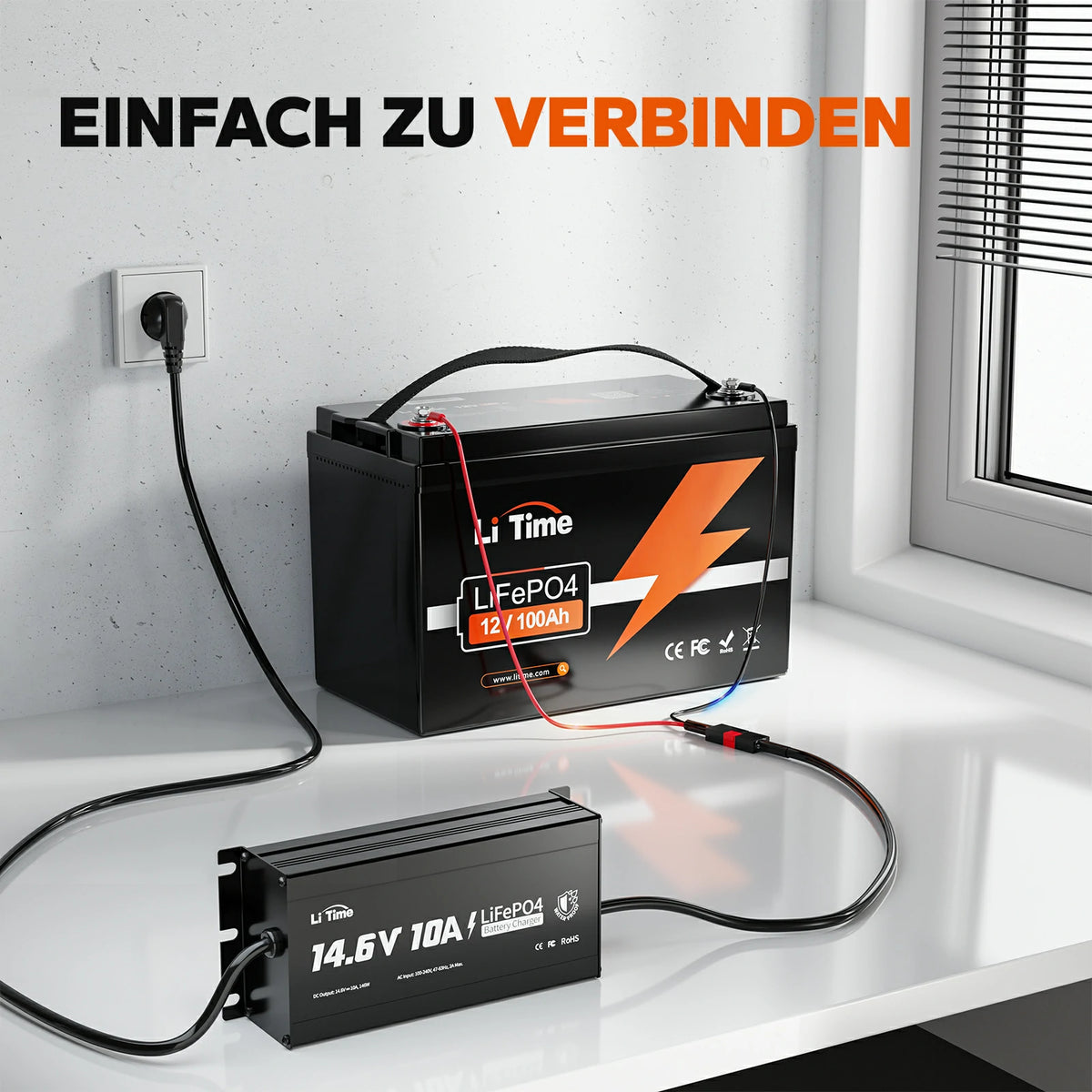
For optimal charging of your battery, it is best to use a LiFePO4 battery charger from LiTime – specifically designed to ensure the correct charging voltage and protect your battery.
Important NOTE:
FAQs about LiFePO4 voltage state of charge table
At what voltage is a 12V battery empty?
Regardless of the battery type, a battery is empty or nearly empty when the voltage is around 11V. To maximize their lifespan, batteries should not be regularly discharged below 50%.
What voltage should a 12V battery have?
The normal voltage range of a 12V battery The voltage depends on its state: 12.6 V - 12.8 V when fully charged, 12.2 V - 12.5 V when partially charged, and below 11 V when almost discharged. During charging, the voltage typically rises to 13.8 V - 14.4 V (for lead-acid batteries) or 14.2 V - 14.6 V (for lithium batteries).
How can I tell the charge level of a battery?
The best way to determine a battery's charge level is by measuring its open-circuit voltage with a multimeter. A fully charged 12V battery has a voltage of 12.6V to 12.8V, while a nearly discharged battery reads below 11.8V. For accurate results, the battery should not have been used for at least 4-6 hours. Alternatively, battery monitors or specific chargers can display the charge level directly.
What is the optimal charge level for a LiFePO4 battery?
The ideal state of charge for a LiFePO4 battery is between 20% and 80% to maximize its lifespan. Regular deep discharge below 10% or continuous full charging to 100% can reduce cycle stability. For optimal performance, a charging range of 30% to 90% and the use of a battery management system (BMS) for monitoring are recommended.
Conclusion
In summary, the state-of-charge table for 12V and 24V batteries offers a simple and effective method for checking the current battery condition based on voltage. Regular voltage measurements allow you to optimize your battery's performance and extend its lifespan. Whether gel, AGM, or lithium batteries – knowing the specific values is crucial for proper handling. With this information, you'll be well-equipped to use your battery efficiently and safely.
LiTime - Your best energy solution
LiTime is an expert in battery manufacturing and offers many types of multifunctional lithium iron phosphate batteries, such as Bluetooth models, heated models and models with cold protection, etc., which will provide you with sufficient energy for your camping activities, motorhome travel and fishing.


