


The tension of a LiFePO4 lithium battery is far more than just a number on a display. It determines what happens next.
- how much energy is still available to you in your motorhome, boat or solar system,
- how securely your system runs and
- how long your battery actually lasts.
In this guide, we'll explain step by step how to create a LiFePO4 voltage table reads correctly, which Charging voltage which is useful and how you can use it 12V, 24V, 36V and 48V systems the appropriate Voltage for the state of charge assesses.
1. Fundamentals of LiFePO4 voltage and state of charge
1.1 Why is the LiFePO4 voltage so important?
The voltage (volts, V) is the most important measurement signal for your LiFePO4 lithium battery. It tells you about:
- the current State of Charge (SoC)
- the strain on the cells
- and, along with electricity and temperature, also provide clues about the State of Health (SoH).
If you understand how the LiFePO4 voltage changes with the state of charge, you can:
- Plan better how long your consumers will still run,
- Avoid overcharging and deep discharging and
- significantly extend the lifespan of your battery.
1.2 Important voltage concepts for LiFePO4
In LiFePO4 (lithium iron phosphate), four types of voltage are particularly important:
Nominal voltage (rated voltage)
The typical operating voltage of a LiFePO4 cell is approximately 3.2 V. Several cells in series result in, for example, a 12V, 24V, 36V or 48V battery.
Charging voltage
This is the maximum voltage to which a LiFePO4 cell is charged – typically up to 3.65 V per cell.
-
- 12V LiFePO4 (4 cells): approx. 14.6 V
- 24V LiFePO4 (8 cells): approx. 29.2 V
- 36V LiFePO4 (12 cells): approx. 43.8 V
- 48V LiFePO4 (16 cells): approx. 58.4 V
Cut-off voltage/discharge limit
This is the lowest technical voltage limit below which further discharge should not occur – usually around 2.5 V per cell.
-
- 12V system: approx. 10.0 V
- 24V system: approx. 20.0 V
- 36V system: approx. 30.0 V
- 48V system: approx. 40.0 V
Storage Voltage
For longer periods of inactivity, a medium state of charge is ideal, usually 3.25–3.30 V per cell (approximately 50% SoC). This reduces aging and capacity loss.
2. LiFePO4 voltage table for 12V, 24V, 36V and 48V
All common LiFePO4 batteries are based on the 3.2V cell. Several cells are connected in series:
- 4 cells → 12V LiFePO4 battery
- 8 cells → 24V LiFePO4 battery
- 12 cells → 36V LiFePO4 battery
- 16 cells → 48V LiFePO4 battery
The following LiFePO4 voltage table shows typical values for voltage vs. state of charge (SoC), specifically as resting voltage – i.e., when the battery is not being heavily charged or discharged.
2.1 LiFePO4 voltage table (3.2V cell → 12V, 24V, 36V, 48V)
| State of charge (SoC, approx.)) | 3.2V cell | 12V LiFePO4 battery | 24V system | 36V system | 48V system |
|---|---|---|---|---|---|
| 100% (fully charged) | 3.65 V | 14.6 V | 29.2 V | 43.8 V | 58.4 V |
| ~90% (resting voltage) | 3.35 V | 13.4 V | 26.8 V | 40.2 V | 53.6 V |
| ~50% (Nominal) | 3.30 V | 13.2 V | 26.4 V | 39.6 V | 52.8 V |
| ~20% (low) | 3.25 V | 13.0 V | 26.0 V | 39.0 V | 52.0 V |
| 0% (cut-off) | 2.50 V | 10.0 V | 20.0 V | 30.0 V | 40.0 V |
2.2 How to use the LiFePO4 voltage table in everyday life
- "Sweet Spot" for long lifespan
Try to operate your LiFePO4 battery mainly between 20% and 90% SoC.
– For a 12V system, this corresponds to approximately 13.0–13.4 V resting voltage.
- When should I reload?
If a 12V LiFePO4 battery drops towards 13.0V while at rest, it's time to recharge – especially in a motorhome, boat or off-grid solar system.
- How can I tell if it's fully charged?
When the battery briefly reaches approximately 14.4–14.6 V (final charging voltage) during charging, it is practically fully charged. During the rest phase, the voltage then drops back to around 13.4 V.
3. Professional tips on LiFePO4 voltage and voltage table
3.1 Resting voltage vs. voltage under load
The LiFePO4 voltage table mentioned above (12V, 24V, 36V, 48V) primarily refers to the open-circuit voltage, i.e., when:
- no charger is connected
- only a slight or no load is applied and
- the battery had a little time to "calm down".
Under heavy load or directly during charging, the measured LiFePO4 voltage may deviate significantly:
- Under load → voltage appears lower (voltage drop due to internal resistance)
- Immediately after charging → voltage appears higher than the typical resting voltage
3.2 Temperature influence on LiFePO4 voltage and capacity
The LiFePO4 voltage also depends on the temperature:
- At low temperatures, the internal resistance increases, the voltage drops faster under load, and the usable capacity appears lower.
- While performance is better at high temperatures, aging is accelerated.
In very cold conditions (e.g., winter camping in a motorhome), do not rely solely on voltage, but also:
- reduce discharge currents,
- Pay attention to the manufacturer's permitted temperature ranges.
- Use LiFePO4 batteries with low-temperature protection or heating if possible.
3.3. Cut-off voltage is the technical limit – not the goal in everyday use.
Many tables list a cutoff voltage of approximately 2.5 V per cell at 0% SoC (10.0 V at 12V, 20.0 V at 24V, 30.0 V at 36V, 40.0 V at 48V). This is the extreme lower limit at which the BMS still provides protection.
It is significantly better for lifespan:
- to limit actual usage to approximately 20–80% SoC or 10–90% SoC,
- Consumers (inverters, motor controllers, DC loads) with a low-voltage disconnect (LVD) slightly above the BMS cut-off voltage are to be switched off.
3.4 Interaction of LiFePO4 voltage, BMS and device settings
The voltage values mentioned (charging cut-off voltage, cut-off voltage, storage voltage) are reference values. In practice, several components interact:
- BMS (Battery Management System)
Monitors cell voltages, currents and temperatures and disconnects in case of emergency (overcharging, deep discharging, short circuit).
- Charger/Solar Charge Controller
They set the final charging voltage (e.g. 14.2–14.6 V for 12V LiFePO4) and operate in CC/CV mode.
- Inverter/DC load/Motor controller
They often have an adjustable undervoltage threshold at which they disconnect the load (e.g. 11.0–11.2 V at 12V, correspondingly higher values at 24V/36V/48V) to protect the battery from deep discharge.
Use the information in the LiFePO4 voltage table as a starting point, but always adjust your devices to match the specific battery model and the manufacturer's recommendations.
4. Charging the LiFePO4 battery: Charging end voltage & CC/CV charging profile
4.1 CC/CV charging principle
To safely and gently charge a LiFePO4 lithium battery, the CC/CV method (Constant Current/Constant Voltage) has become established:
CC phase (constant current)
- The charger supplies a fixed current (e.g. 0.2–0.5 C).
- The battery voltage increases until the set charging voltage is reached.
CV phase (constant voltage)
- The charger keeps the voltage constant (e.g. 14.4–14.6 V at 12V).
- The charging current decreases as the battery becomes fuller.
This ensures that the last approximately 10–15% of capacity is charged gently.
4.2 Recommended charging voltage for 12V LiFePO4
The following guidelines have proven effective for a 12V LiFePO4 battery:
- Final charging voltage (absorption): approx. 14.2-14.6 V
- Use a compatible charger: specifically for LiFePO4 with CC/CV profile
- Do not charge below 0 °C: at sub-zero temperatures, only charge with appropriately approved, possibly heated, LiFePO4 batteries.
Recommended articles:
- What is low-temperature protection for lithium batteries?
- Energy independence in winter: LiTime batteries for your off-grid system
5. LiFePO4 battery discharged: Cut-off voltage, DoD & BMS protection
5.1 Safe undervoltage limits
For a 12V LiFePO4 system, the following serves as a rough guideline:
- lower technical limit (cut-off): approx.10.0 V
The scale is similar for other voltage levels:
- 24V system: Cut-off approx. 20.0 V
- 36V system: cut-off approx. 30.0 V
- 48V system: Cut-off approx. 40.0 V
It's better to switch off earlier so the BMS doesn't constantly have to go into emergency mode. Typical real-world values:
- 12V: LVD at approximately 11.0-11.2V
- 24V: LVD slightly above 22V
- 36V: LVD slightly above 32–33 V
- 48V: LVD slightly above 44V
5.2 Depth of Discharge (DoD) and Lifetime
The deeper you discharge your LiFePO4 battery, the greater the stress it will be under per cycle:
- up to 80% DoD (from 100% to 20%) → very good compromise between usable capacity and lifespan
- Up to 100% DoD (up to the cut-off voltage) → maximum capacity, but significantly more cell stress
For stationary solar storage systems, motorhomes and boats, it is therefore worthwhile to limit regular operation to 20–80% SoC or 10–90% SoC.
5.3 Role of the BMS during unloading
The BMS (Battery Management System) monitors:
- Cell voltages
- Charging and discharging currents
- Temperatures
and protects against:
- Overvoltage (overcharge)
- Undervoltage (deep discharge)
- Overcurrent/Short circuit
- impermissible temperatures
Ideally, your appliances or inverters should shut down slightly before the BMS limit, so that the BMS only has to intervene in a real emergency.
6. Measuring LiFePO4 voltage: Multimeter, battery monitor & Bluetooth
Regular voltage measurements help you keep track of the charge level and monitor your system.
6.1 Method 1: Multimeter

A digital multimeter is the simplest tool to quickly check the LiFePO4 voltage:
- Disconnect the load and charger if possible.
- Set the multimeter to DC voltage (for 12V: 20V range, for 24V/36V/48V correspondingly higher).
- Red probe on positive terminal, black probe on negative terminal.
- Read the voltage and compare it with your LiFePO4 voltage table (12V, 24V, 36V, 48V).
6.2 Method 2: Battery Monitor
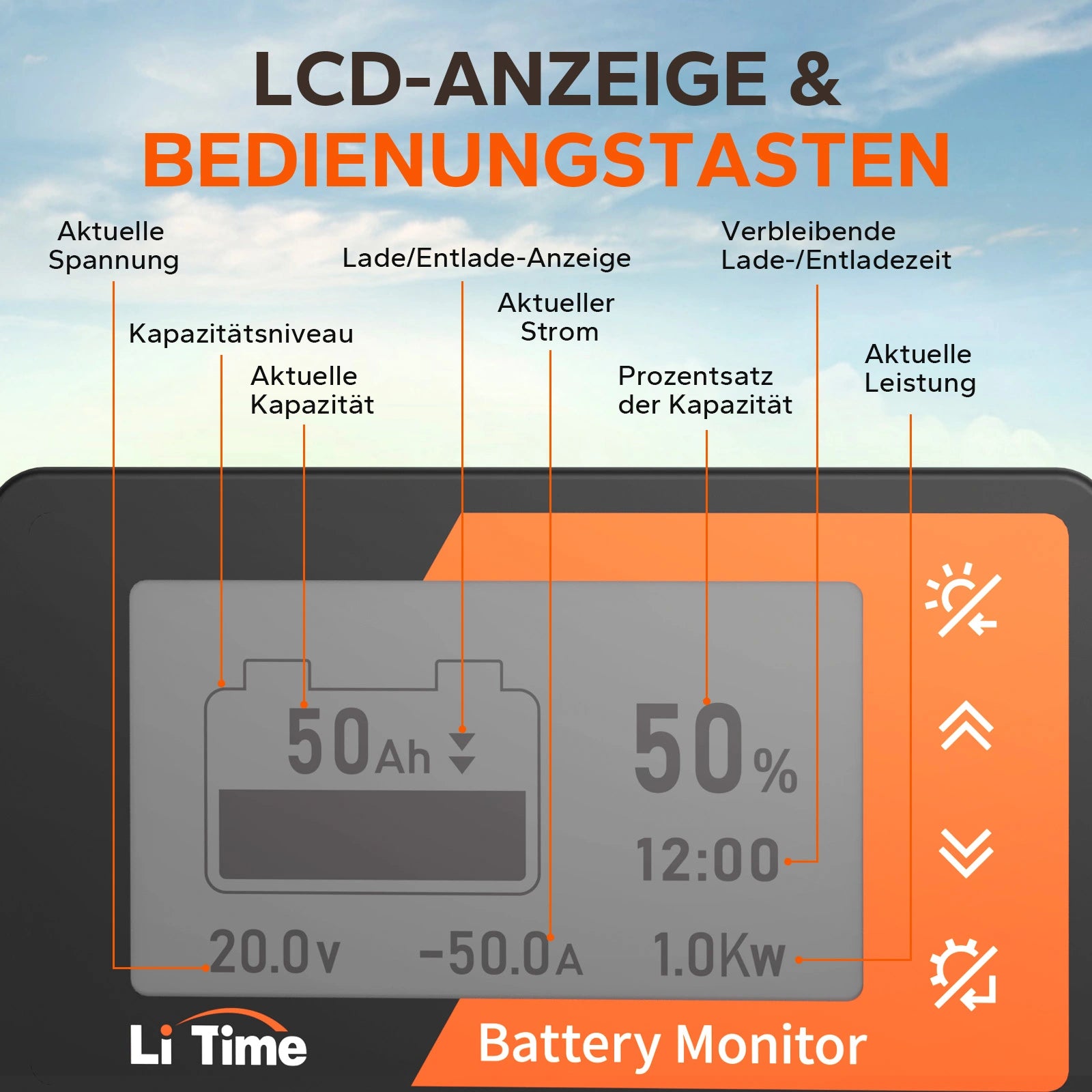
A battery monitor measures not only the voltage, but also:
- Current (A)
- Capacity used/charged (Ah)
- often also a calculated SoC in %
This allows you to see very clearly:
- how much energy you actually use in everyday life,
- how long your consumers can still run,
- how your system behaves over days and weeks.

6.3 Method 3: Bluetooth App (Smart LiFePO4 Battery)
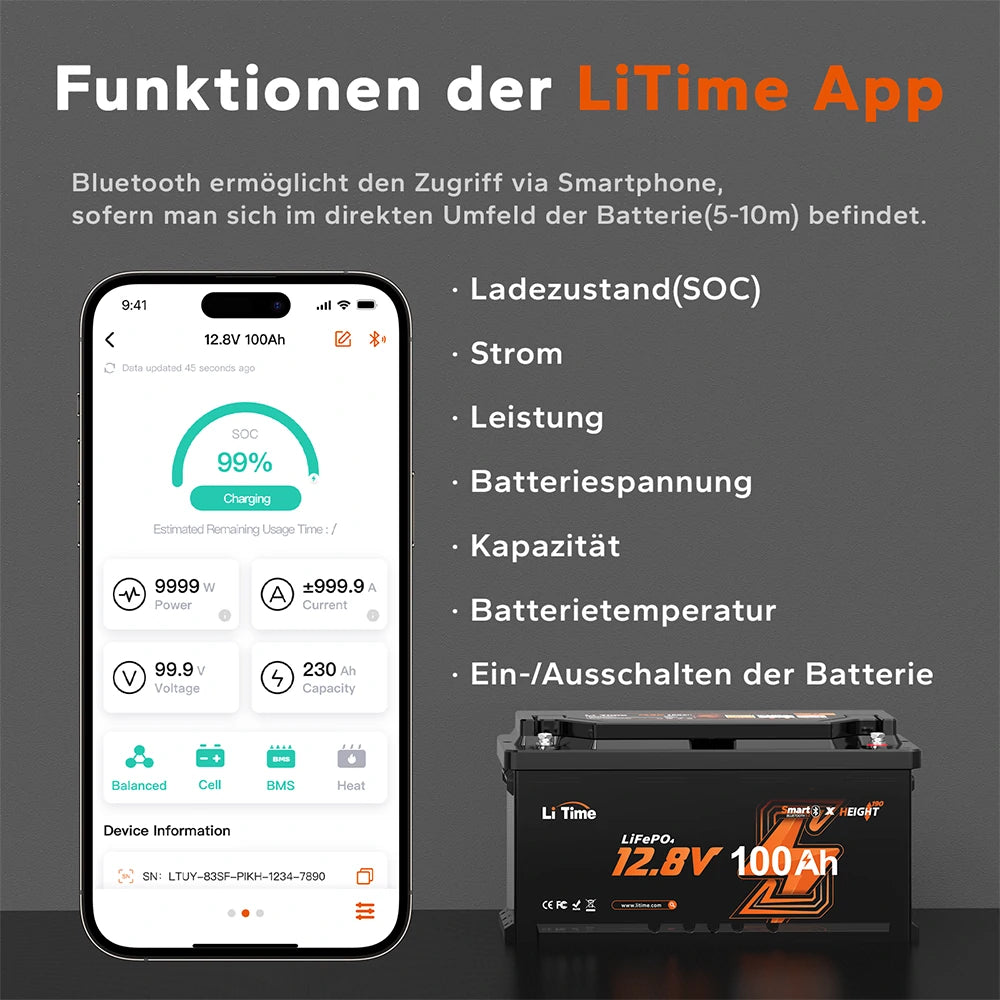
Many modern LiFePO4 batteries have a built-in Bluetooth module. You can control them directly via a smartphone app:
- Cell voltages
- Total voltage (12V/24V/36V/48V)
- Charging/discharging currents
- Temperature and BMS status
Readout – perfect for motorhomes, boats or garden sheds.

7. Conclusion: LiFePO4 voltage table as a practical tool in everyday life
A good LiFePO4 voltage table for 12V, 24V, 36V and 48V turns abstract voltage values into a concrete decision-making aid:
- When should I reload?
- How full is my battery right now?
- What is the ideal charging voltage for my system?
- Where do I set the undervoltage cutoff to prevent deep discharge?
If you:
- You understand the basics of LiFePO4 voltage
- You set your devices (charger, solar charge controller, inverter, motor controller) with sensible voltage values and
- respect the limits of your battery,
You get the maximum performance from your lithium iron phosphate battery – whether in a motorhome, on a boat, in an off-grid house or in industrial applications.
8. FAQ about LiFePO4 voltage and LiFePO4 voltage table
8.1 What LiFePO4 voltage corresponds to approximately 50% state of charge?
For a 12V LiFePO4 battery, 50% SoC is typically at a resting voltage of about 13.2V.
Accordingly:
- 24V system: approx. 26.4V
- 36V system: approx. 39.6V
- 48V system: approx. 52.8V
8.2 What is the ideal charging voltage for a 12V LiFePO4 battery?
In practice, 14.2–14.6 V has proven effective. Those aiming to maximize battery life can choose the lower end of the range (e.g., 14.2 V) or avoid driving to 100% SoC in every cycle.
8.3 Can I connect three 12V LiFePO4 batteries in series to create a 36V system?
- Yes, that's possible – but only if:
- All three batteries are the same model.
- the same charge level and
- They should ideally be the same age.
Furthermore, the charger, motor controller and BMS must be designed for 36V LiFePO4 voltage.
8.4 Is the LiFePO4 voltage different in cold weather?
Yes. Internal resistance increases at low temperatures:
- The voltage drops more significantly under load.
- The usable capacity appears lower
Therefore, plan conservatively in cold weather, preheat if necessary, or use a LiFePO4 battery with integrated heating.
8.5 Can I simply transfer my old lead-acid charger settings to LiFePO4?
Partly, but not always ideal. The crucial factor is whether:
- The charging voltage is suitable for LiFePO4 (e.g. 14.2–14.6 V at 12V)
- Avoid prolonged trickle charging at excessively high voltage
When in doubt, a dedicated LiFePO4 charging profile (or a genuine LiFePO4 charger) is the safer choice.


