


If you your Calculate electricity consumption If you want to do this, questions quickly arise: "How many watts does this device have?" "How much does it cost per day?" and "What is the difference between kW and kWh?"
The short answer: W/kW describes the power (the "speed" of consumption), kWh describes the amount of energy consumed ("how much"). This is exactly how it can be used. electricity costs Estimate in a comprehensible manner.
- 1. What is electricity consumption? Meaning and unit
- 2. kW vs. kWh: The difference explained briefly
- 3. Calculating electricity consumption: Formulas and conversions
- 4. Calculate electricity costs (electricity costs per kWh)
- 5. 3-step method: How to calculate electricity consumption
- 6. Examples: Quickly estimate electricity consumption and costs
- 7. Solar + storage: reduce "purchased kWh"
- 8. Calculate battery life: How long will a given capacity in kWh last?
- 9. High electricity consumption: typical energy guzzlers & Money-saving tips
- 10. FAQ
- 11. Conclusion: Performance is "speed", costs arise from "quantity"
What is electricity consumption? Meaning and unit
The electricity consumption In everyday language, this usually refers to the electrical power a device consumes during operation. This power is measured in Watt (W) or Kilowatt (kW) specified.
- The higher the power (W), the higher the costs can be – if the device runs for a long time.
- The electricity bill depends not only on the power consumption, but above all on the... Running time (hours).
For calculation purposes, the information on the nameplate ("power consumption: ... W") is usually perfectly sufficient (the value may vary depending on the mode).
kW vs. kWh: The difference explained briefly
For Calculate electricity consumption The difference is crucial: kW stands for performance (currently), kWh for energy (summed over time).
- W/kW: Power – “how much” or “how quickly” electricity is consumed.
- Wh/kWh: Energy – “how much” electricity was consumed in total
Key point: electricity costs are usually after kWh billed – that is, according to quantity, not according to current performance.
Calculating electricity consumption: Formulas and conversion
Calculate electricity consumption works reliably with two components: Power (kW) and Duration (h). If you want to understand the principle, these formulas will help:
Direct Current (DC): Basic Formula
- Power (W) = Voltage (V) × Current (A)
Alternating current (AC): with power factor (optional)
- Power (W) = Voltage (V) × Current (A) × Power factor
Note: For household appliances, the power rating is usually given directly in W – this is the easiest way to calculate.
Calculate kWh: Energy quantity for billing
To electricity costs To calculate this, you first need the amount of energy in kWh.
- Energy (kWh) = Power (kW) × Time (h)
- kW = W ÷ 1,000
Example: A 60W device runs for 5 hours.
- 60 W = 0.06 kW
- 0.06 kW × 5 h = 0.30 kWh
This 0.30 kWh are the amount of energy consumed.
Quick table: Watt → kW → kWh
Typical values for guidance (for continuous operation; in practice it may differ due to on/off cycles):
| Power (W) | Power (kW) | Energy in 1 hour (kWh) | Energy in 24 hours (kWh) |
|---|---|---|---|
| 30 | 0.03 | 0.03 | 0.72 |
| 60 | 0.06 | 0.06 | 1.44 |
| 100 | 0.10 | 0.10 | 2.40 |
| 300 | 0.30 | 0.30 | 7.20 |
| 600 | 0.60 | 0.60 | 14.40 |
| 1,000 | 1.00 | 1.00 | 24.00 |
| 1,500 | 1.50 | 1.50 | 36.00 |
Calculate electricity costs (electricity costs per kWh)
Billing is almost always based on kWh – therefore “electricity costs per kWh“The most important bill in everyday life.”
- Electricity costs (€) = Energy (kWh) × Price (€/kWh)
The price per kWh varies depending on the provider and tariff. For the following examples, we will use... 0.29 €/kWh as a calculated value.
3-step method: How to calculate electricity consumption
If you're wondering "How is electricity consumption calculated?“, then simply proceed as follows:
- W → kW: W ÷ 1,000 = kW
- kW → kWh: kW × hours = kWh
- kWh → €: kWh × €/kWh = electricity costs
Examples: Quickly estimate electricity consumption and costs
Three short examples will show you how electricity consumption (kWh) electricity costs at 0.29 €/kWh develop.
Example 1: Mini-fridge (60 W) runs for 24 hours
- 60 W = 0.06 kW
- 0.06 kW × 24 h = 1.44 kWh
- Electricity costs = 1.44 kWh × €0.29/kWh = €0.42 (rounded)
A refrigerator doesn't run at full power (compressor on/off) constantly. Nevertheless, the following applies: Even small wattages add up to noticeable kWh over many hours.
Example 2: Electric blanket (100 W) runs for 8 hours
- 100 W = 0.10 kW
- 0.10 kW × 8 h = 0.80 kWh
- Electricity costs = 0.80 kWh × €0.29/kWh = €0.23 (rounded)
Heating appliances often cause higher energy consumption – depending on the level, temperature and duration of use.
Example 3: Hair dryer (1200 W) runs for 10 minutes
- 1200 W = 1.20 kW
- 10 minutes = 10/60 h = 0.166… h
- 1.20 kW × 0.166… h = 0.20 kWh (approx.)
- Electricity costs = 0.20 kWh × €0.29/kWh = €0.06 (approx.)
The hairdryer is a typical example of high performance in a short time. Frequent use still adds up.
Solar + storage: reduce “purchased kWh”
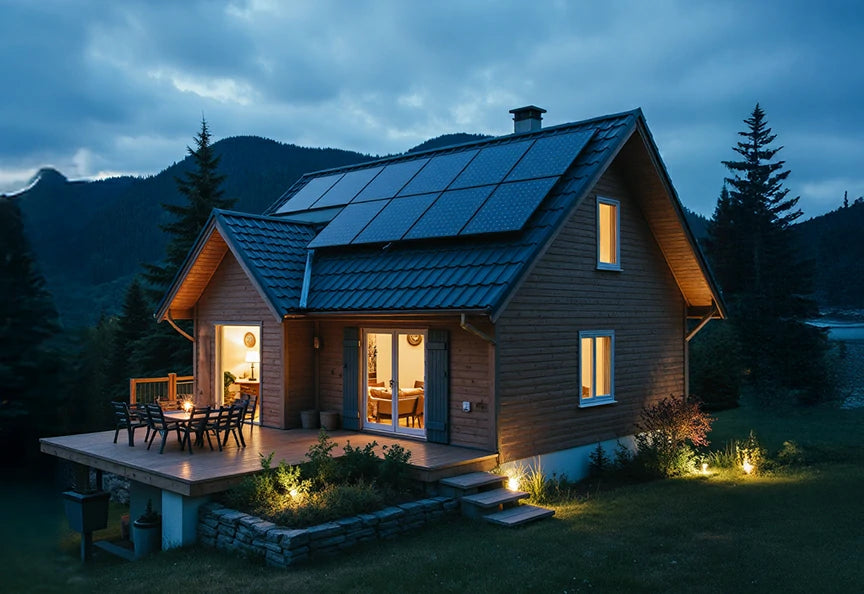
If you electricity costs If you want to reduce your energy consumption, in addition to efficiency, the source also helps: solar power and a storage system can reduce the amount of "purchased kWh".
- Electricity costs (€) = kWh purchased × price (€/kWh)
- Fewer kWh purchased → potentially lower electricity costs
The extent of the effect depends, among other things, on solar radiation, consumption profile and tariff.
Calculate battery life: How long will a given capacity in kWh last?
In outdoor, emergency power, or work applications, the operating time of a device is often crucial. The approximation is simple:
- Runtime (h) = Battery capacity (kWh) ÷ Device power (kW)
Example: Battery capacity 1.0 kWh
- 60W (0.06kW) → 1.0 ÷ 0.06 = 16.7 h (approx.)
- 300W (0.30kW) → 1.0 ÷ 0.30 = 3.3 h (approx.)
- 1,000 W (1.0 kW) → 1.0 ÷ 1.0 = 1.0 h (approx.)
A notice: In practice, conversion losses (inverter), temperature, usable capacity, and starting currents shorten the operating time. Therefore, plan for a reserve.

High electricity consumption: typical energy guzzlers & Money-saving tips
Typical energy guzzlers
devices with high electricity consumption They can often be recognized by the fact that they generate heat or draw a very high amount of power for short periods.
- Heat generator (Fan heater, kettle, toaster)
- Engine/Compressor (Refrigerator) – Performance fluctuates during operation
- High performance for short periods (Microwave, hairdryer)
4 simple money-saving tips
To electricity costs To lower the pressure, one of these levers usually helps:
- Reduce service life
- Use more efficient mode (Eco, lower level)
- Avoid continuous operation (Check standby, "always running" mode)
- Targeted use of high performance (use only when needed, in bundles)
The important thing is: Don't just look at wattage – kWh are crucial.
FAQ
How is electricity consumption calculated?
You calculate electricity consumption using the amount of energy: kWh = kW × h. First, let's talk about this. W ÷ 1,000 = kW and then multiply by the runtime.
How do I calculate electricity costs per day or month?
Basic formula: Electricity costs (€) = kWh × €/kWh. To calculate per day/month, multiply the kWh by the number of days.
What is the difference between kW and kWh?
kW describes the current performance ("how strong"), kWh The total amount of energy consumed ("how much over time"). Billing is usually done in kWh.
How do I convert watts to kWh?
In two steps: W ÷ 1,000 = kW, then kW × hours = kWh. Example: 100 W for 8 h → 0.10 kW × 8 h = 0.80 kWh.
Why can the actual power consumption differ from the rating plate?
Many devices do not run at full power continuously (thermostats, compressors, eco modes). Therefore, actual power consumption fluctuates depending on the settings and environment.
Electricity consumption for 1 person vs. electricity consumption for 2 people – what is typical?
At the Electricity consumption for 1 person many uses are lower than with the Electricity consumption for 2 people. At the same time, a base load (router, refrigerator) is incurred regardless of the number of people. electricity costs for 1 person What matters is which devices run and for how long – not just the size of the household.
How do I calculate the runtime of a battery using kWh?
Approximation: Runtime (h) = Battery capacity (kWh) ÷ Power (kW). Conversion losses and starting currents can shorten the runtime.
Conclusion: Performance is "speed", costs arise from "quantity".
- W/kW = Power (currently)
- kWh = Amount of energy (kW × h)
- electricity costs = kWh × Price (€/kWh)
- Battery life = kWh ÷ kW
If you know, How is electricity consumption calculated?, This will help you better estimate costs and save money in a targeted way. Take the wattage from the rating plate and your usage time – and do the math.


